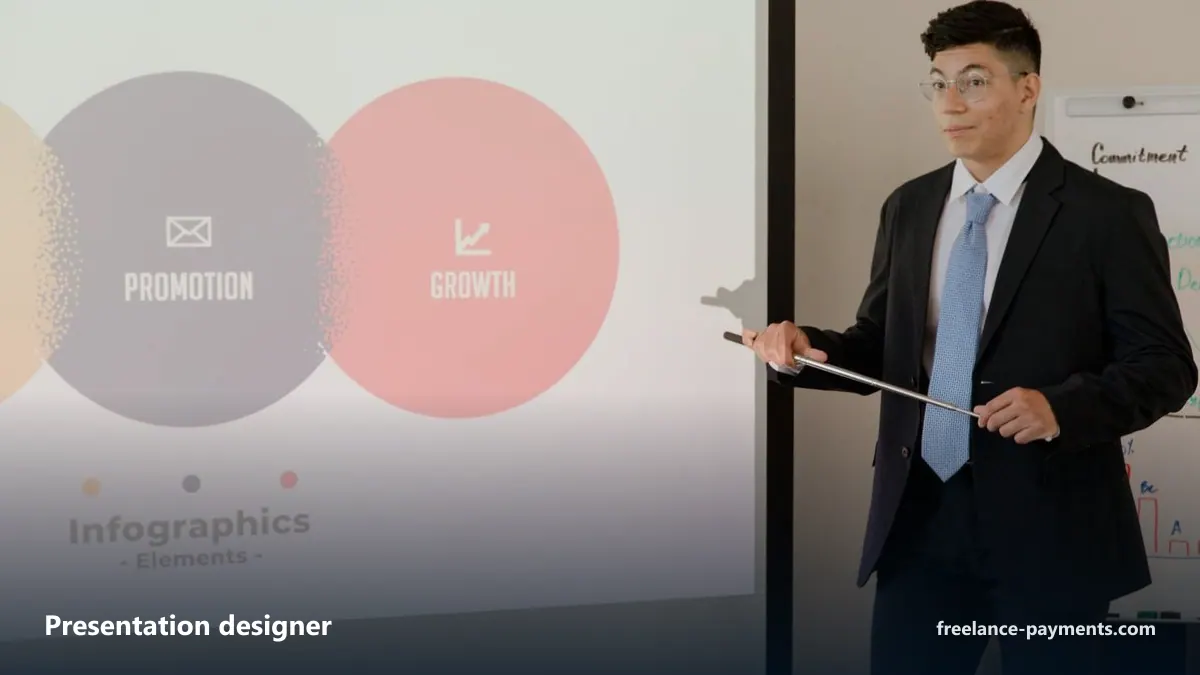
Why cross-border invoicing slows down payment
When a presentation designer in another country sends an invoice to a US client, the finance team sees a foreign supplier. The invoice asks for a wire transfer to an overseas bank, and the bank may ask for extra information, hold the payment for review, or charge a fee that was not agreed. The client's accounts payable department is set up to pay US vendors. They expect a W-9, a domestic bank account, and the ability to pay by ACH without thinking about exchange rates or international routing.
This is not hostility. It is just how US payment systems are built. A company that pays dozens of US suppliers every week has a smooth process. A single foreign invoice interrupts that process. The person approving the invoice may not know how to start a wire, or may have to ask a supervisor, or may simply set the invoice aside because it looks unusual. The designer did the work, sent the files, and now waits.
That is a lot of friction for a deck that was finished at midnight before a morning meeting.
What changes when the invoice comes from a US company
PANORAMA payments inserts a US company between the client and the designer. The designer still does the work and still communicates with the client as before. But the invoice is issued by a US company, with a US bank account, and the client pays by ACH or wire in dollars. If the client asks for a W-9, one is provided. The client's accounting system treats the payment as an ordinary domestic transaction.
The client does not need to know that the designer is outside the United States. They might know, because the designer told them, but the payment process does not depend on that knowledge. The invoice can be issued in US dollars, euros, pounds, or any of eleven currencies, but the client pays in dollars to a US account. For the client, nothing about the payment is foreign.
The designer registers once, verifies identity, and describes the work. After that, every invoice follows the same path. The client pays the US company, and then the designer is paid in their own country. There is no subscription and no charge before the client pays.
Getting paid in your own country
After the client pays the US company, PANORAMA payments sends the money to the designer. The method depends on where the designer is. It can be a bank transfer to a local account, a SWIFT payment, SEPA within Europe, Wise, or a payment in dollar-denominated digital assets. The platform deducts one fee and sends the rest.
This is the point where many cross-border services add complexity. PANORAMA keeps it simple: the client pays in the United States, the designer receives money at home. No one has to manage two currencies or open a foreign bank account. The designer keeps working with clients in their own time zone and their own language, and the money arrives in a form they can use.
The platform does not give tax advice. The designer remains responsible for their own taxes wherever they live. PANORAMA is not an employer and does not withhold anything except the platform fee.
Billing for presentation work, unchanged
Presentation designers bill in three common ways: a fixed price for a defined deck, a price per delivered slide or template, or tracked hours invoiced weekly or monthly. PANORAMA does not change that. The designer and the client still agree on the price and the scope. The invoice records the same line items, whether it says "Investor pitch deck, fixed price" or "Data slides, per slide" or "Design hours, two weeks".
The difference is only in the payment rails. Instead of sending a wire to a foreign account, the client pays a US company. This matters most when the work is urgent. A presentation designer often delivers the night before a board meeting or a fundraising pitch. The client approves the invoice after the meeting, when the pressure is off. If the invoice looks foreign, it can wait another week. If it looks domestic, it gets paid with the next regular batch.
That is the practical benefit: the designer's work is judged on the quality of the slides, not on the complexity of the payment.